The Slow Rearrangement of a Life: Notes From a Caregiver
“Ayushman Bhava” – the traditional blessing of a long life seems to be coming true with Indians living longer. But when long life is not accompanied by good health, what about the caregivers’ plight?
A first-person account from an empathetic but tired caregiver.
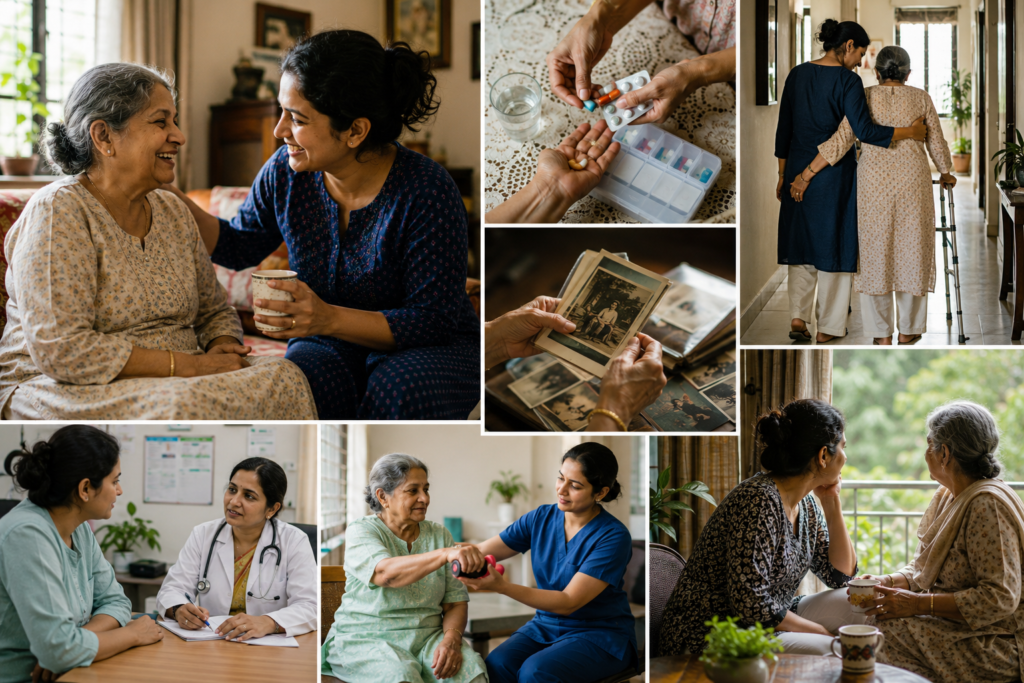
India, with its expanding elderly population and shrinking joint-family systems, is entering a phase where care work will increasingly fall on families, particularly women.
Some sounds quietly become part of your nervous system. The creak of the bathroom door at 2 am. The slight pause before someone stands up from a chair. A steel tumbler falling in another room. The silence that stretches a little longer.
I did not become a caregiver overnight. It happened in fragments, through hospital visits, medication reminders, dietary restrictions pasted onto refrigerators, learning the names of blood markers, and the gradual understanding that someone else’s body has now entered the centre of my mental landscape.
My mother-in-law has an autoimmune condition. Some days she is energetic enough to insist on making coffee for everyone in the house. On other days, she cries in pain, or a sudden bout of acidity makes her sit up till dawn with uneasiness. Illness has made time unpredictable. Plans are tentative. Fatigue permeates the house like the weather.And somewhere along the way, caregiving stopped being an “event” and became an atmosphere.
This is happening across India, and more families are facing this reality. People are living longer, but longevity is accompanied by chronic illnesses that demand sustained care. Dementia, Alzheimer’s disease, Parkinson’s disease, strokes, arthritis, autoimmune disorders, osteoporosis and age-related frailty are becoming increasingly common in urban and semi-urban households. In many homes, elderly care is no longer occasional support. It is a second full-time ecosystem operating inside family life.
Dementia and Alzheimer’s, in particular, alter not just memory but relationships themselves. Families often speak about the grief of watching someone slowly lose familiarity with everyday things, forgetting names, repeating stories, becoming disoriented inside their own homes. Caregivers describe a peculiar loneliness in caring for someone who is physically present yet gradually becoming cognitively distant.
Parkinson’s disease brings a different kind of emotional strain. The tremors and stiffness are visible, but less discussed are the depression, sleep disturbances, slowed speech, and loss of independence that accompany the condition. Everyday actions such as buttoning a shirt, holding a cup or walking across a room begin to require assistance and patience.
Then there are illnesses that are less publicly understood but equally consuming. Autoimmune diseases, chronic pain disorders, neurological degeneration and post-stroke disability often fluctuate unpredictably, making caregivers live in constant adjustment mode. A good week can suddenly collapse into hospitalisation, exhaustion or complications.
India is ageing rapidly. According to estimates by the World Health Organization, the number of people living with dementia globally is expected to nearly triple by 2050.
But statistics do not capture the strange emotional choreography of caregiving. They do not tell you how often caregivers scan faces for signs of pain before the person themselves acknowledges it. Or how guilt arrives in contradictory forms, guilt for feeling exhausted, guilt for wanting time alone, guilt for resenting the interruptions, guilt for not doing enough.
In middle-class Indian homes, caregiving is still spoken about as duty, affection and sacrifice; nobody refers to it as labour.
There are no appraisal systems for caregivers. No weekends. No emotional off-switch. Even those of us who are not primary caregivers live in a state of partial alertness. A phone call during work hours can instantly rearrange the day. Dinner conversations revolve around test results, insurance claims, specialist appointments, inflammation levels, and physiotherapy schedules.
Sometimes I think the hardest part is not the physical work but the invisibility of anticipation. Caregivers are constantly preoccupied with what might happen next.
Will she fall? Did she take the evening medication? Why is she quieter today? Should we call the doctor now or wait till morning?
Researchers studying caregivers of elderly people with dementia and neurological conditions have repeatedly found that caregivers experience chronic stress, disrupted sleep, anxiety, social withdrawal, and deterioration in their own physical health. Yet many caregivers do not identify themselves as caregivers at all. They simply see themselves as family members doing what is expected.
Women, especially, are expected to absorb care work seamlessly into their existing identities as daughter , daughter-in-law, wife, mother, and professional. Caregiving becomes one more invisible layer beneath everything else. Many caregivers now speak openly about needing support systems of their own, therapy, respite care, community groups, flexible work structures, and financial planning. But Indian caregiving culture still glorifies endurance more than support.
We praise people for managing everything instead of asking why they have to do it by themselves.
And yet, there are moments of startling tenderness.
The careful folding of a shawl after an afternoon nap. The relief of hearing laughter after a difficult week. Sitting beside someone during a medical infusion and discussing utterly ordinary things like mango prices, neighbours, old Tamil songs, the jasmine plant needing more sunlight.
Illness sharpens intimacy in unexpected ways. I have also realised that elderly care is not only about medicine. It is about preserving dignity.
It is about allowing slowness in a world obsessed with productivity. It is about recognising that dependence is not failure. It is about understanding that people do not stop needing beauty, conversation, humour, routine, or purpose simply because they are unwell.
Perhaps that is what caregiving ultimately teaches you, not saintliness, not selflessness, but fragility. The body’s fragility. Time’s fragility. The fragile illusion that independence is permanent.
You begin to understand ageing not as something that happens to “old people,” but as a slow rearrangement waiting quietly for all of us.
And some evenings, after everyone has slept, I sit alone with a cup of tea gone cold beside me and think about how entire lives eventually narrow into small acts of care.
A hand steadying another hand. A reminder to eat. A light left on in the corridor. A voice from another room asking softly, “Are you awake?”
- Janani Sampath is Senior Editor at The Good City.