Memory, Mathematics, and a Living Tradition Drawn in Rice Flour
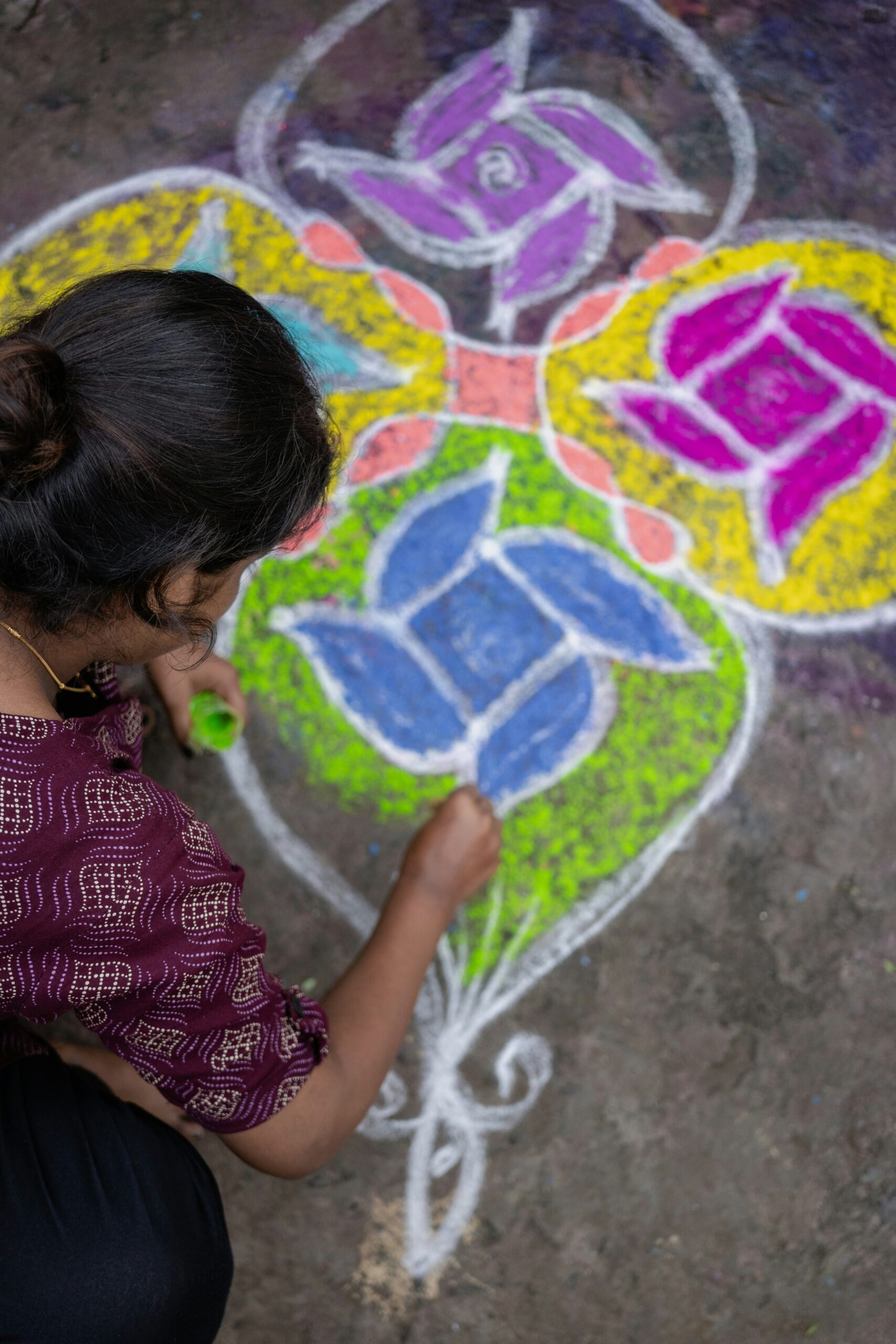
Drawn at dawn and erased by dusk, the kolam is far more than a decorative pattern at the threshold. This centuries-old Tamil tradition weaves together art, ecology, mathematics, memory, and women’s knowledge systems, revealing how an everyday ritual continues to adapt, endure, and inspire in a rapidly changing world.
The ritualistic kolam that you see sketched out in front of thresholds is not merely a decoration. What looks simple on the surface is layered with symbolism, history, mathematics, spirituality, and memory — a whole interior universe rendered in white powder on stone.
Interestingly, it’s also been a code for communication in certain communities. Just by looking at the kolam drawn in front of a household, the neighbourhood would know if there’d been a birth in the family or another auspicious event. In many Tamil households, specific kolams marked specific occasions. Some belonged exclusively to Fridays and Lakshmi worship. Others appeared during Margazhi mornings, weddings, puberty ceremonies, harvest festivals, or temple rituals. Designer and photographer Udhaya Sankar says that in parts of Tamil Nadu, specific designs once indicated whether a family was welcoming a newborn or preparing for a ceremony.
Remarkably, the kolam is not merely decorative but represents mathematical concepts. Every element of a kolam carries weight. Triangles, circles, lotus forms, lamps, and geometric grids echo older ideas about balance, energy, rhythm, and cosmic order. In sikku kolams especially — where continuous lines weave around a grid of dots in complex, unbroken loops — the designs begin to feel less like drawings and more like unsolved puzzles. For decades, women created these sophisticated geometric systems without ever calling them mathematics. Today, mathematicians, designers, and computer scientists study kolams with genuine fascination — examining the structural complexity embedded in their symmetry, recursion, looping systems, and algorithmic logic. Recent studies have even explored pulli kolams as frameworks for physical data representation and computational mapping, demonstrating how a threshold pattern drawn before sunrise can speak directly to the concerns of twenty-first-century design and technology.
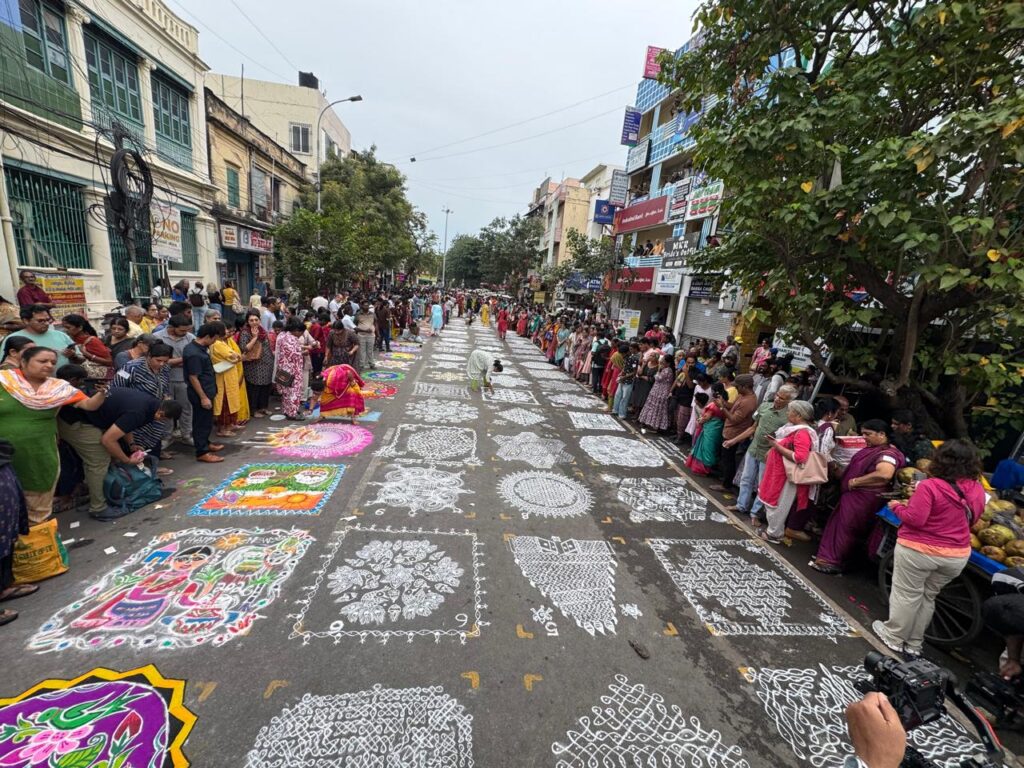
Kolam competition at the annual Mylapore Festival in Chennai. Photo Courtesy: Mylapore Festival Facebook Page
Generations of women practised these principles intuitively — transmitted through oral tradition, imitation, and repetition, requiring no textbooks, no classrooms, no formal validation.
The kolam is one of the oldest surviving forms of visual expression in South India. Historical traces reach back to Sangam literature, roughly between 300 BCE and 300 CE. Andal mentions kolams in Nachiar Tirumozhi. Shaivite texts and medieval Tamil poetry return repeatedly to decorated thresholds and ritual drawings. What likely began as the simple scattering of rice at entrances gradually evolved into intricate visual systems — knowledge passed from woman to woman, generation to generation, without a single written manual.
Similar floor art traditions exist across India under different names: rangoli in Karnataka, muggu in Andhra and Telangana, and alpana in West Bengal are drawn free-hand and include shapes of deities, flowers, and lamps. The pookalam in Kerala is a floral rendition of the rangoli. The kolam is akin to chowkpurna in Uttar Pradesh, which is also geometric and begins with a meticulous creation of a grid of dots.
But the Tamil kolam occupies a distinct cultural space because of its radical ordinariness. It was never reserved for festivals or ceremonies. It belonged to unremarkable mornings, doorsteps, daily routines, and the unacknowledged labour of women. A unique feature of a kolam is that it starts with creating a grid of dots wh
In her book, ‘Mother, Mother-Community and Mother-Politics in Tamil Nadu’, writer and researcher C. S. Lakshmi has observed that kolams embody rhythm, symmetry, recursion, and continuity — even when the women making them would never think to use those words. Meenakshi notes that the practice of sprinkling rice at entrances eventually evolved into kolam-making, turning everyday ritual into visual language. There is also an ecological philosophy woven into that origin. The choice of rice flour was historically tied to a belief that every household owed something to other living beings. The kolam fed ants, birds, squirrels, and insects even as it beautified the entrance.
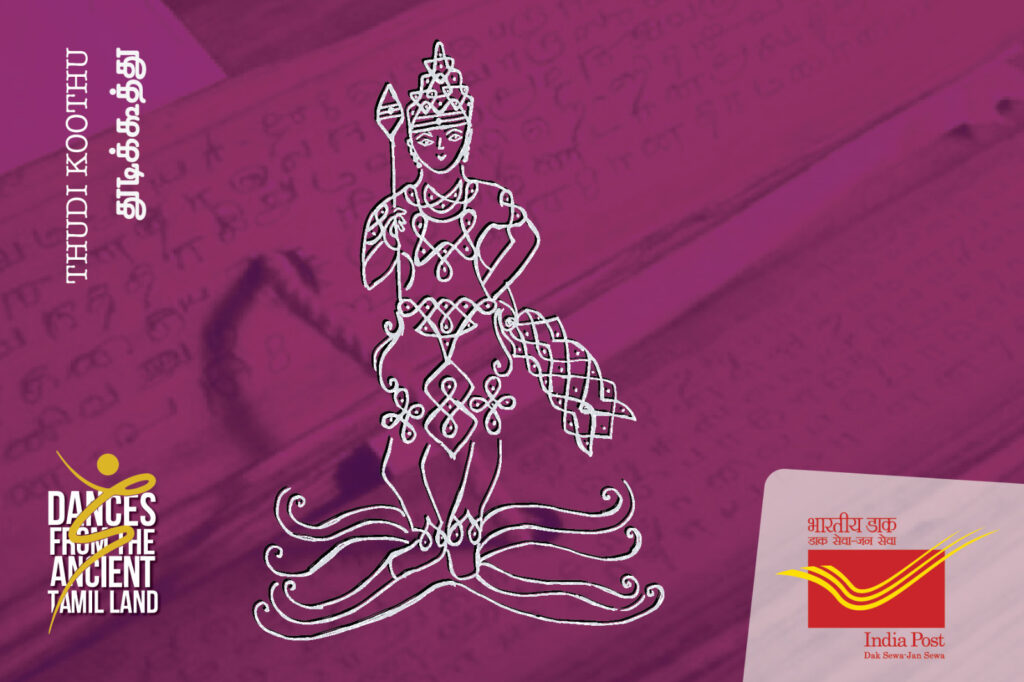
The language of kolam has since crossed the threshold of the household entirely and made its way to a wider world. Historian Meenakshi Devaraj has worked on bringing the art form into public institutional spaces and has designed a series of kolams as a tribute to the Tamil Koothu (folk dance form) for India Post in 2025. The traditional motif had travelled from the ground outside a home to the face of official correspondence, without losing anything of itself in the journey. Photo Courtesy: Meenakshi Devaraj
Urban life has transformed the practice. In apartment complexes and fast-changing cities, rice flour has largely given way to chalk powder, acrylic colours, sticker kolams, and stencil designs. Meenakshi observes that intricate kolams, especially sikku kolams, are slowly receding from everyday life as simpler rangoli-style patterns increasingly take their place. Yet the practice has not disappeared. It has adapted with a quiet stubbornness. Kolams now circulate through Instagram tutorials, digital archives, animation projects, textile design, and diaspora communities spread across the world. During the pandemic, online kolam challenges became an unexpected anchor — a way for people to restore routine and a sense of continuity when everything else had come undone. Traditional designs have also found unlikely new takers in fashion and textile spaces, with designers incorporating kolam motifs into contemporary clothing and visual identity.
Meenakshi urges that preservation must move beyond aesthetics and nostalgia. One of the most meaningful ways to sustain the tradition, she believes, would be to bring kolams into school curricula through subjects like mathematics and science. “Recently, a school mathematics question used kolam structures as part of a case study for students to solve; it is an important step toward making learning more rooted and engaging,” she says. Integrating kolams into classrooms, she argues, could break the monotony of conventional teaching while helping students discover mathematical thinking, symmetry, and pattern recognition through a living cultural practice rather than an abstract exercise. She also calls for stronger institutional recognition for kolam practitioners — a state-level award or formal recognition for kolam artistes, she argues, would restore dignity and visibility to one of Tamil Nadu’s most enduring yet largely unstaged art forms.
The kolam has pushed further still — into the space of politics and public resistance. Protest kolams emerged during demonstrations and civic movements, transforming what had always been a domestic practice into a subtle, subversive act of dissent. Slogans and political symbols appeared inside traditional geometric designs, turning ordinary thresholds into sites of public statement. These conversations have simultaneously reopened older ones about labour and gender. For generations, kolam-making was dismissed as domestic duty — invisible, routine, unworthy of acknowledgement — despite the memory, precision, discipline, and design intelligence it quietly demanded. Today, scholars and artists increasingly recognise kolams for what they always were: repositories of women’s intellectual and cultural labour, hiding in plain sight on the ground.
The threshold itself carries meaning. A kolam was never meant for galleries or preservation. It was public, participatory, visible, and deliberately impermanent — and that impermanence, that willingness to make something extraordinary and simply let it go, perhaps lies at the very heart of the practice.
Before sunrise, across towns and cities in Tamil Nadu, women still step outside their homes with rice flour in hand. In a movement learned through watching rather than being taught, they bend toward the earth and begin drawing. Traditionally made during ‘brahma muhurtham’, the hour believed to pulse with spiritual energy just before sunrise, the kolam marks the exact meeting point between interior world and exterior life.
American art historian Stephen Huyler says he was ‘bewitched’ by the ingenuity of the kolams. He first encountered them as a 20-year-old while travelling in India in the 1970s when he woke before dawn to find women outside every house painting designs on the street. In his book, ‘Painted Prayers: Women’s Art in Village India’, he observed that as daylight spread, he watched entire roads become a huge mural — only for everything to vanish within hours under the movement of daily life.
This is the enduring appeal of memory and mathematics which are intertwined in this living Tamil Tradition. Every morning, before the city fully awakens, someone still bends toward the ground and begins drawing. By evening, the design will disappear under footsteps, rain, or traffic. By dawn the next day, it will return.
– The Good City Crew