
The Good City Podcast
In The Good City: Inside a Jaguar Mark 2 with Tilak Thomas
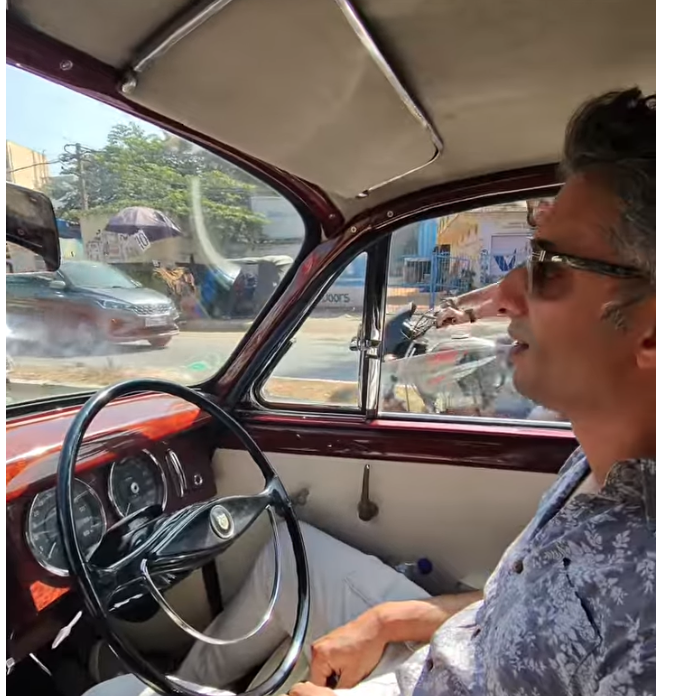
In the Good City Classic Cars edition in Bangalore, a Jaguar Mark 2 becomes more than a backdrop—it becomes a moving conversation space, a place where memory, mechanics, and family history fold into each other.
On this drive, In The Good City’s Aditya Mendonca caught up with architect Tilak Thomas to talk about what it really means to own a vintage car in India today: not as a collectible, but as a long-term relationship.
The conversation begins, as these things often do, with sound, ignition, and ritual.
The car doesn’t simply start. It needs to be coaxed into life.
There is a pause, a familiar sequence of movements—hands adjusting, a brief check, the quiet negotiation between driver and machine.
“One second, let me just get it ready…”
And in that small act, something becomes clear: this is not about convenience. It is about attention.
Because owning a vintage car, as Tilak explains, is never just about ownership. It is about continuity—between people, generations, and the machines they refuse to let disappear.
A natural thread runs through the conversation: family.
He speaks about growing up around his father, watching him work, and eventually becoming part of the same rhythm.
“I grew up watching my father do all this; he involved me in the process a lot,” he reflects. Over time, that exposure becomes involvement, and involvement becomes shared work—especially in a family-led business where lines between personal and professional are constantly overlapping.
In India, that overlap is not unusual. What stands out instead is how it shapes passion projects like this one: not as side pursuits, but as extensions of a family’s way of working and thinking.
The car itself carries a story that stretches beyond Bangalore.
Tilak recalls how it came into his life through a friend, Suresh Sitaraman, whose own connection to the vehicle began in Singapore.
It once belonged to Suresh’s boss there—an object of admiration for a young professional working abroad. When the opportunity came, Suresh acquired it and brought it back to Bangalore, a transnational journey for a machine that had already lived more than one life.
“He really coveted that car; he had his eye on it the whole time,” Tilak notes, describing how aspiration often attaches itself to objects long before ownership becomes possible.
There is even a moment of surprise in the retelling—when the conversation touches on Suresh’s identity and his work, a brief reference linking him to DC Comics, and then back again to something more grounded: the car, its movement, its return, its eventual wear.
Because the reality of vintage ownership is rarely glamorous for long.
“A few mechanics had worked on it before I got it—it had issues for so many years—and we realised we had to rebuild the car,” Tilak says.
Rebuilding is not cosmetic. It is an act of commitment. A decision to keep something alive even when it resists being simple.
“It’s not something you can just take out for a Sunday drive.”
And that, perhaps, is the point of it all.
Outside the city, where Bangalore eventually gives way to quieter stretches of road, the conversation settles into what these cars really offer: not speed, but presence. Not efficiency, but engagement.
A vintage car demands participation. It slows time down enough for stories to surface—about fathers and sons, about businesses built within families, about objects that travel across continents and still find their way back into local garages.
For Aditya Mendonca and Tilak Thomas, the drive becomes less about destination and more about the shared understanding that some things are kept alive not because they are easy, but because they are worth the effort.
With thanks to @madhustyres and @nikhil_bee for the hospitality.
#jaguarmark2 #inthegoodcity #classiccar #lifeinbangalore