The Hidden Realms of Hindustani Classical Music
By: Janani Sampath
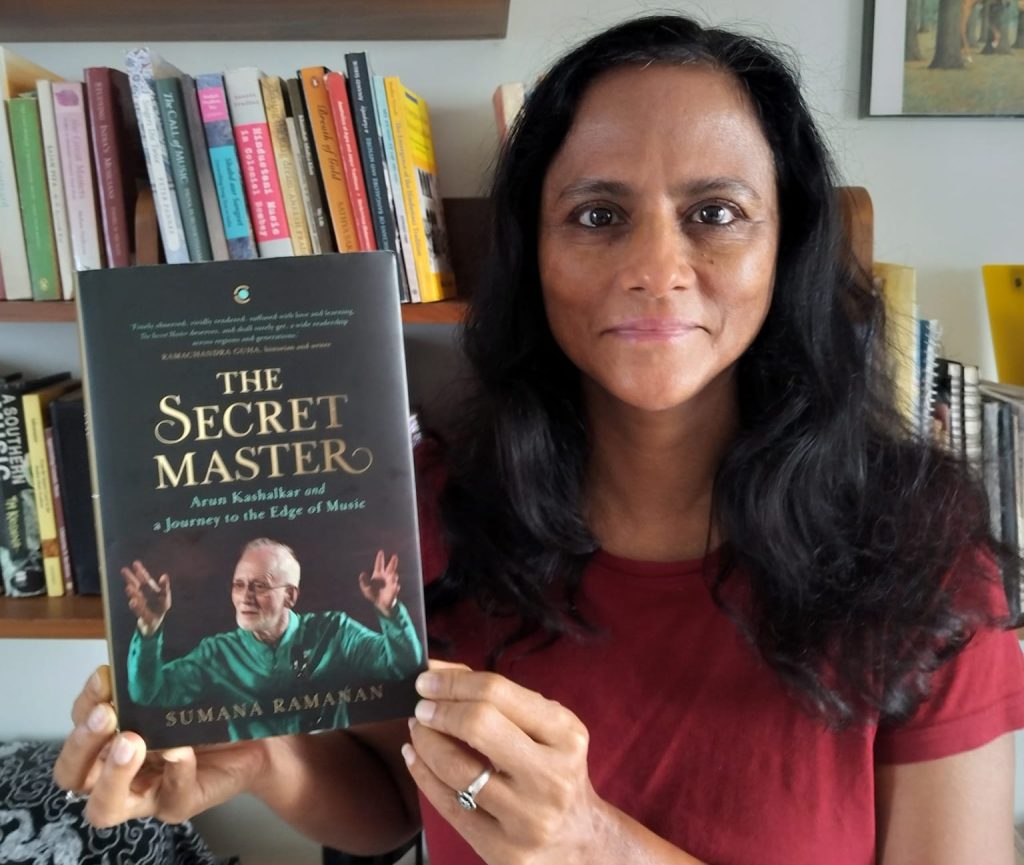
Journalist and writer Sumana Ramanan’s latest book, The Secret Master: Arun Kashalkar and a Journey to the Edge of Music, is in parts reportage, memoir, and cultural history to explore music, mastery, and artistic excellence.
In 2016, journalist and writer Sumana Ramanan, a trained singer herself, attended a concert by Hindustani vocalist Arun Kashalkar. What began as an ordinary evening of listening soon turned into a question that would occupy her for nearly a decade and eventually become a 500-page book.
At first, she admits, she was unsure what to make of the performance. Kashalkar was already in his seventies and his voice was not at its peak. But as the concert progressed, something remarkable unfolded. There was the rare nom-tom alap associated with the Agra gharana, intricate rhythmic patterns, a seamless weaving together of multiple gharana traditions, and an extraordinary sense of control over tempo and structure.
“I sat up and thought, ‘Oh my God, somebody is still doing this,'” Sumana recalls. By the end of the evening, another question had begun to nag at her. “If this musician is so accomplished, why have I not heard more about him?”
That question led her to pen The Secret Master: Arun Kashalkar and a Journey to the Edge of Music, a book that is at once biography, memoir, reportage, cultural criticism, and a meditation on artistic recognition. While Kashalkar remains at its centre, the book ultimately asks a much larger question: Who decides who become stars and who remain hidden from public view?
Following a Trail of Clues
The mystery did not begin with that concert, as shortly before hearing Kashalkar perform, Sumana had started writing a column on Hindustani classical music in Mumbai. His name surfaced in conversations, while musicians and students referred to him. Listeners spoke of him with admiration, but he remained largely absent from the public spotlight.
“It wasn’t as though I was looking for him,” she says. “But his name kept cropping up. “The concert seemed to confirm what those scattered references had suggested. Here was a musician who was not only a performer but also a composer, scholar and teacher, surrounded by an unusually devoted community of students.
Curiosity led Sumana to Kashalkar’s home, where she began attending classes while researching a profile. What she expected would be a brief journalistic project gradually became something far more immersive. She enrolled as a student herself, intending to learn for a couple of years while her twin children prepared to leave for college.
Instead, she found herself drawn deeper into the world of Hindustani music. “The music sucked me in,” she says.
As her understanding grew, so did the scope of the project. What began as a profile evolved into an exploration of an entire ecosystem comprising teachers, students, organisers, critics, institutions, patrons and audiences.
“It wasn’t only his life story anymore,” she explains. “There were all these narratives woven around it.”
More Than a Biography
Sumana is quick to point out that The Secret Master is not a conventional biography. “It’s not a biography per se as he is a metaphor. “That metaphor extends far beyond one musician’s life. Kashalkar’s relative obscurity despite his accomplishments becomes a lens through which to examine the state of Indian classical music and, more broadly, the ways in which contemporary culture assigns value.
The book investigates the structures that shape artistic recognition. Who organises concerts? Who receives funding? Which musicians are promoted? Which aesthetic styles flourish and which are sidelined? For Sumana, these questions are inseparable from larger economic and cultural shifts that have transformed the performing arts over the past few decades.” The issue isn’t only about music,” she says. “It’s also about the systems that determine what the public hears.”
The Problem of Visibility
One of the book’s most provocative arguments concerns the growing disconnect between artistic excellence and public recognition. Writing the book forced her to confront uncomfortable questions about fame and merit. If musicians of Kashalkar’s calibre remain relatively unknown, what exactly determines visibility?
Her investigation led her towards patronage structures, market forces and institutional priorities. Classical music, she argues, is particularly vulnerable to commercial pressures because it takes years of listening and learning to develop informed taste.Unlike mass entertainment, where popularity can be measured instantly, the appreciation of a raag’s depth, architecture and improvisational sophistication requires sustained engagement.
“The aim of the classical musician is to improvise within a raag,” she says. “Most listeners don’t really know what criteria to use when judging a performance.”
Instead, audiences often focus on easily accessible markers such as vocal sweetness, speed or dramatic flourishes. Thoughtful exposition, originality and rhythmic sophistication can become secondary considerations. The result, she suggests, is a system that increasingly rewards visibility over depth.
Learning from the Inside
What distinguishes The Secret Master from many books on music is her position within the story itself. She was not merely an observer but also a participant.
As an adult learner entering a demanding musical environment populated by younger, more accomplished students, she continued to unravel the different facets of music. Learning the music gave her access to dimensions of the art form that would have remained invisible to an outsider. It also exposed her to the complexities of writing about a teacher who had become an important presence in her life.
“There was a power relationship,” she acknowledges. “He was my guru. At the same time, I was writing about him.”
The challenge was to maintain journalistic integrity while remaining sensitive to the trust that such access required. Fortunately, she says, Kashalkar’s openness made that task easier. “He lived his life almost in public,” she says. “There was very little distinction between public and private.”
A Hidden Community
Perhaps the most hopeful aspect of Sumana’s account is her portrait of the community that exists beyond the spotlight. The book documents a vast network of dedicated teachers, serious students, and committed listeners who continue to sustain Hindustani music outside mainstream visibility.While she worries about the commodification of art and the shrinking space for serious cultural criticism, she finds encouragement in the persistence of these communities.
Many of Kashalkar’s students have themselves become teachers. They continue to train new generations of musicians and listeners, often with little public recognition. “They may not all become professional performers,” she says, “but they will become very good listeners.” In an era obsessed with metrics, visibility, and reach, that may be a form of cultural preservation every bit as important as producing stars.
The Long View
For Sumana, whose career has spanned journalism, editing, and cultural writing, the book represents both a culmination and a new beginning. Drawing on influences ranging from literary nonfiction to social history, she has produced a work that combines investigation with personal reflection, using one musician’s story to illuminate broader questions about culture, power and value.
The mystery that first confronted her in a concert hall nearly a decade ago remains relevant today. Why do some artists become household names while others remain known only within specialist circles or in oblivion? What gets lost when markets become the primary arbiters of cultural worth?
The Secret Master does not offer easy answers as it invites readers to look beyond the spotlight and pay attention to the quieter traditions that continue to shape India’s artistic life. For Sumana, the journey began with a simple question: Why have I never heard of this musician? The answer, she discovered, says as much about us– the connoisseurs–as it does about the musician himself.
Janani Sampath is Senior Editor at The Good City.