Startup Heat Map: Hyderabad
Hyderabad’s startup scene is stepping out of its storied neighbour Bengaluru’s shadow quietly and surely, and is building a playbook for durability, discovers Aditya Mendonca.
Chief Minister Revanth Reddy reflected this with the poise and confidence he announced that Telangana and Hyderabad are not competing with any city in India. “China + 1 is Telangana,” he reiterated at a recent interaction with the venerable journalist and editor N Ram at The Hindu Huddle ideas conclave. “We are competing with Germany, Japan, and South Korea. What’s true for manufacturing is also true for the technology sector. While it was Chandrababu Naidu (as Chief Minister of undivided Andhra Pradesh) who fired the first salvos in the battle for tech investment, Revanth Reddy made no bones about carrying on ‘friendly matches’ with Bengaluru. The fact that Telangana was the state sponsor for the conclave organised in Bengaluru was a clear signal of his intent.
This confidence is also visible in the quieter signals: the research lab at IIIT that spins out companies in quick succession and the MNC bank that chose to open a GCC in Hyderabad after just one visit.
For years, Hyderabad played second city to Bengaluru in the Indian startup imagination. That framing is being called out by influential investors like Prashanth Prakash, who said while announcing the release of the WeAreCity 2026 report, “Bengaluru is still ahead, but Hyderabad represents a powerful, infrastructure-led playbook for urban growth. The gap is closing faster than I expected.”
The ecosystem in Hyderabad has developed along lines that are genuinely distinct — less performative but more patient and technical.
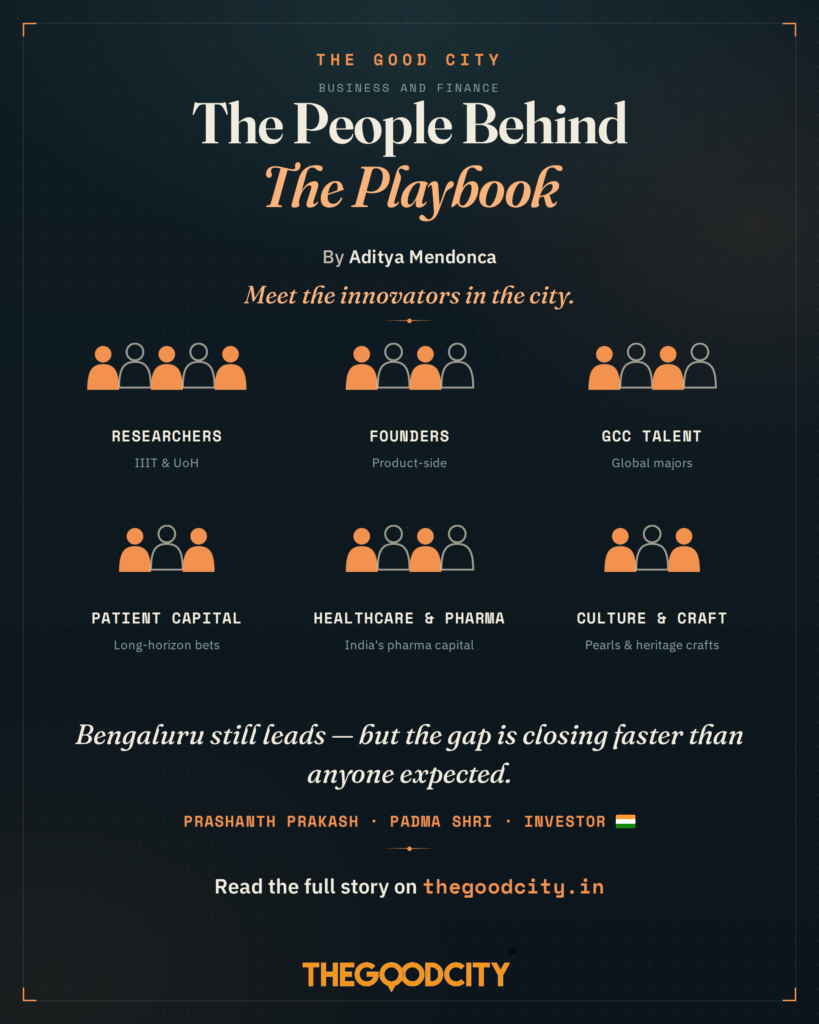
The heat right now is concentrated at the technical end of the spectrum — though not in the way funding headlines would suggest. Deep tech and AI infrastructure companies are emerging from a research base that has been building for years, anchored by talent from IIIT Hyderabad and the University of Hyderabad. Funding for the sector has cooled sharply since its 2024 peak, in line with a broader pullback in deep tech capital nationally — but the underlying work continues: model efficiency, semiconductor design tools, drug discovery pipelines. The kind of work that builds durable companies, even if it takes longer to attract a headline round.
While life sciences has long been central to Hyderabad’s identity as India’s pharma capital, the translation layer has evolved significantly. The path from molecule in a lab to a cap table is shortening, thanks to a growing cohort of experienced mentors who have successfully navigated that journey. Furthermore, local capital is notably patient; rather than chasing the next quick unicorn, investors are backing complex projects that may take seven years to mature but offer defensible, long-term value.
Healthcare and pharma remain Hyderabad’s clearest sectoral identity — WeAreCity puts it at 15.4% of Grade A office leasing, more than triple Bengaluru’s share. That foundation is now being actively reinforced: Telangana’s life sciences sector attracted over ₹84,000 crore (approximately $8.8 billion to $10 billion) from 2024 to 2026, upping Telangana life sciences ecosystem is valued at $145 billion.
On the startup side specifically, healthtech has been the standout — Telangana government data shows Hyderabad’s tech startup funding rose 160% in 2024 to $571 million, driven largely by healthtech and fintech. HealthTech secured nearly $300 million, saw a staggering 2,139% vertical jump, while FinTech pulled in $105 million. Late-stage rounds made up $297 million of the total investment.
But 2025-2026 saw it drop to $236 million, resulting in a pivot towards early-stage sustainability
A quieter shift is underway among the IT services veterans of HITEC City and Gachibowli. Where earlier enterprise software ventures were often founded by people who’d spent years in services, building products for markets they understood from the outside, a newer cohort is coming from the product side of those same companies — with sharper instincts about what enterprise buyers actually want versus what they say they want.
Conversely, certain sectors are cooling. Consumer and D2C brands have struggled to gain traction compared to Delhi or Mumbai, largely due to Hyderabad’s lack of a specialised influencer infrastructure and retail-driven aspiration. Similarly, Ed-tech is contracting in line with national trends; the local market has always favored vocational and technical training over the enrichment products that experienced a brief surge in popularity.
The geography of this growth is distinct. While HITEC City remains the prestigious address for pitch decks, the actual innovation is spread across a corridor stretching from Gachibowli to Madhapur, with unique pockets of activity in Banjara Hills. Notably, the ecosystem is understated; you won’t find the cafe clusters typical of Bengaluru where every screen shows a design file. Instead, the work happens quietly in mid-floor offices, modest university labs, and private rooms where founders focus on building rather than announcing.
This self-restraint is perhaps the most distinctive thing about Hyderabad’s startup culture. It has costs: the city does not generate the ambient excitement that attracts a certain kind of early talent or early capital. This is reminiscent of the early years of pharmaceutical companies, which struggled to attract the right talent to make them big brands. But they persevered, and so will the current start-ups. Being circumspect about announcing before they are ready also means that what gets built here tends to be less subject to the hype cycles that have made other ecosystems brittle.
Hyderabad is figuring out what it actually wants to build. And once it does, people and businesses are already primed to move there. As Shaker Dixit, founder of Amealio, an AI-powered food experience platform, responded to Prakash’s post, “Bengaluru built the ecosystem, but Hyderabad is clearly emerging as a powerful growth market.”
| Sector / Metric | Period | Amount / Value |
|---|---|---|
| Tech Startup Funding | 2024 | $571 Million |
| Tech Startup Funding | 2025–2026 | $236 Million |
| Life Sciences Investment | 2024–2026 | ~$8.8 – $10 Billion |
| Life Sciences Ecosystem Valuation | 2026 | $145 Billion |
And the cafes might be getting there too. An upmarket cafe in the plush Banjara Hills neighbourhood firmly favours digital-only payment. While this is a baseline assumption in Bengaluru, its emergence in Hyderabad signals that the digital rhythm of Hyderabad is aligning with, and beginning to mirror, more established tech ecosystems.

Aditya Mendonca is Executive Editor of The Good City.