The Work Beneath the Work: Remembering Girish Karnad Through Kusumaale
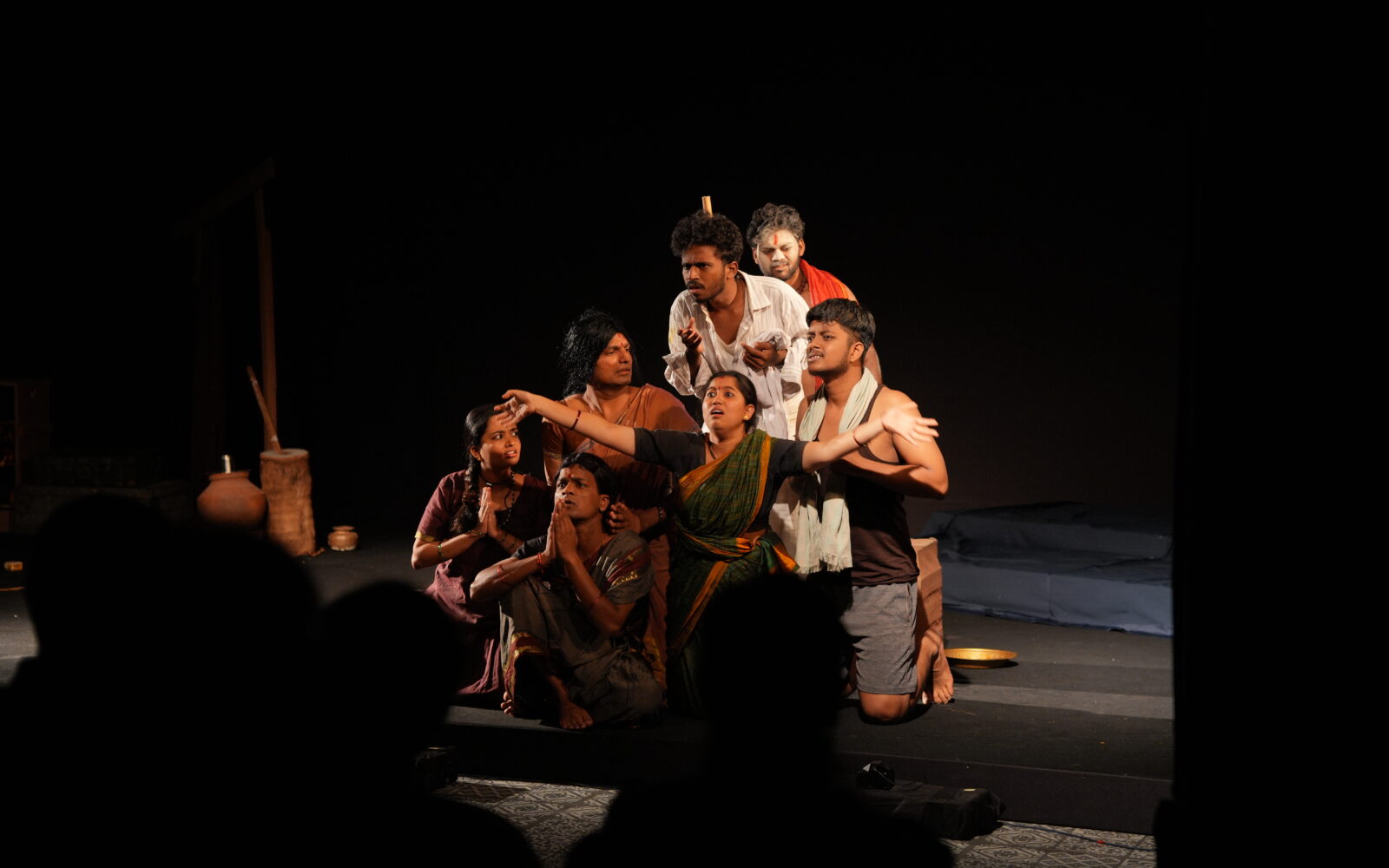
What goes into creating a play is often far more than what eventually appears on stage. In this reflective account, theatre producer and actor Vivek Madan looks back at the making of the Kusumaale fellowship, workshop, and festival in memory of Girish Karnad.
The Timeline hung just inside the entrance to PCPA – a blow-by-blow account of what had led up to the audience’s entry into the theatre to watch the play, reading or seminar of the day.
While going through it with our designer (and longest-serving colleague!) Aakriti Chandervanshi to format and make it presentable to the public as they entered the venue, I remembered the first email I wrote about what would eventually become Kusumaale. It is dated February 22, 2024.
Looking back, I am struck more by what the email doesn’t contain than by what it does. Almost everything that eventually came to define or be the programme emerged afterwards.
But let me go back a little. When we started thedramalibrary.com in 2022, it certainly addressed the core problem of access. But it exposed another absence. Access to scripts was not the same as access to playwrights. Access to playwrights was not the same as encouraging new playwrights. And encouraging new playwrights, I was beginning to realise, meant thinking about everything that happens before a script finds its way into a library.
They are not different problems. They are different parts of the same conversation.
Brecht@2023 was the first commission we offered, capitalising on that great playwright’s 125th birth anniversary. Then came Third Bell, to create space for contemporary playwriting in Bangla. Third Bell is now in its second year, with two scripts already written in 2025 and three more on the way.
So, I suppose Kusumaale was born of the same impetus. How do we put playwriting at the centre of a creation process? How do we put rigour at the centre of the playwriting process? And how do we put opportunity in the hands of deserving, discerning people?
A Fellowship that was open to all, ending in a Festival that celebrated, included and looked forward. A hat tip to StageRite and Writers’ Bloc, which had paved the way so many years ago.
And why in the name of Girish Karnad? B. Jayashree, founder of Spandana and renowned actor, put it best in her inaugural address: “Girish was a towering pillar of Indian theatre, but above all, he was a master playwright who understood the mechanics of the stage like no other. He took our myths, our history, and our folklore and gave them a sharp, modern edge. Yet, he always kept his eye on the future. He was always eager to see what the next generation would create.”
I don’t remember thinking of these decisions as especially radical. It simply felt difficult to justify doing otherwise.
Cut to the jury selection. Our formidable facilitators Irawati Karnik, Lakshman KP Sathwik NN and Yeshaswini Channaiah, read 39 anonymous applications from across the state. I remember Lakshman saying, “I had no idea so many people were interested in writing plays in Kannada!”
During our selection, we weren’t trying to discover whether the applicants were right for the Fellowship. We were trying to understand whether the Fellowship was right for them, whether and how we could help them on their journey.
II
The first residency arrived almost too soon. Though by then we had spent months talking about Kusumaale. There had been proposals and budgets, applications and jury meetings, venue recces and logistics calls. Looking back, I realise I had begun to think of the Fellowship almost entirely as a thing that needed to be managed.
Then eleven playwrights walked into Visthar. I remember an odd sensation of relief. Not because everything had finally come together. Far from it. But because, for the first time in many months, I wasn’t the one doing most of the talking. Around this time I also discovered another occupational hazard of producing: Ownership. Control. The obsessive kind.
One evening, after a relatively normal day of watching facilitators and playwrights wrangle ideas out of thin air, I was in the room with the facilitation team, and I remember I lost my temper about something fairly insignificant. I can’t remember what, but I remember feeling disgruntled that on Day 3 or 4 or whatever it was, we weren’t where I’d imagined we would be. I snapped at Sathwik, and he was understandably confused. Ira smoothed things over, as was her wont. But the next day Sathwik asked me why I had been so grumpy. And I sighed and apologised, explaining that I had lived with this for so long that it was getting to me. He nodded understandingly.
But after that I let go. I let things proceed as they would. Well, mostly.
Fortunately, the playwrights had no interest in my fatigue or dissatisfaction.
They arrived carrying entirely different concerns.
One was worried about structure. Another was confused about who their protagonist was and what they actually wanted. Someone had no idea how to end a scene. Someone else had been living with ideas for years but hadn’t committed to them, on paper or otherwise. Many wondered if they needed all this rigour, all homework, this kind of thinking. Wasn’t writing just picking up a pen and writing?
The conversations in the room, it turned out, had very little to do with the Fellowship and everything to do with writing.
The programme no longer needed to be explained. It was being inhabited.
Looking back, I think that was the first moment it genuinely stopped belonging to me. And I was truly grateful.
One of the pleasures of sitting through those sessions was watching Ira and Lakshman work. They had entirely different instincts and approaches; Lakshman would ask questions relentlessly while Ira would jump in to try and untangle the knots along with the playwright, also relentlessly. But they were similar in two critical aspects – they were generous with their time, knowledge and doubts; and they were both less interested in producing better scenes than in producing better questions.
That distinction stayed with me. Along with another exhortation of Ira’s which she would come back to nearly every day when addressing the playwrights. “What is the play that only you can write?”
That reminds me of the preponderance of applications we had received which centred around myths and epics. For everyone, this was mystifying, and also a non-starter. We all, and Lakshman in particular, were clear that we wanted modern stories, not just modern settings or twists to ancient narratives. We actually asked one of the candidates in our conversation, “Why are you writing about xyz from this old story?” And with disarming honesty, the candidate said, “Because the characters are already written; their behaviour and backstories are already apparent. It’s easier.”
So Ira’s repeated ask made complete sense. It made the playwrights draw on their lives, their surroundings, neighbours, colleagues, family. Their observations, inferences, and insights into people and situations. Which was the absolute right direction.
At the end of the first residency, the playwrights all had a reasonable idea of the world of the play they wanted to write. The players, their obstacles, their wants, their journeys. Now they had to write.
III
The second residency felt different almost from the moment it began.
Partly because the playwrights had changed. They now arrived carrying drafts instead of ideas. Some had written more than they intended, others considerably less. One or two confessed that they had spent several weeks avoiding their play altogether. I found this strangely reassuring – deadlines can have the same effect on producers and playwrights.
But the real difference was that actors had entered the room.
Until then, the plays had existed almost entirely inside the playwrights’ heads and on the pages they had cautiously shared with the mentors. Now they belonged to voices, bodies, spaces and silences. Lines that had seemed perfectly satisfactory on paper suddenly made no sense. Characters who were funny and quirky were just silly and without reason. A pause became more eloquent than a paragraph. A joke no one had noticed caused an entire room to erupt in laughter.
It is a peculiar thing to watch a playwright hear their own work for the first time.
After living with an idea long enough, one begins to mistake stewardship for ownership. The transition that the work will continue perfectly well without your constant – or reduced – intervention is both humbling and liberating.
Watching the actors improvising scenes and possibilities around the scaffolding of the texts, I found myself thinking about the ecosystem these works were slowly entering. A play does not emerge only because a playwright writes it. It emerges because a surprising number of people, often working in obscurity, make it possible for that playwright to keep writing. Readers. Dramaturgs. Actors. Directors. Producers. Translators. Audiences. Institutions willing to fail more often than they succeed. None of these is ancillary to the work. They are the work beneath the work.
IV
Around this time, as we were starting to plan the Festival that would conclude the Fellowship, Ujwala Rao (the Associate Festival Director) and I found ourselves returning repeatedly to the same question.
What exactly were we inviting people to?
The obvious answer was a playwriting festival – complete in itself, its genesis, its rigour, its honesty.
But there’s always more.
Ujwala, in her note for the brochure, articulated it beautifully. She described the performances as “the presentable tip of an extraordinarily unruly iceberg.”
The performances remained at the heart, and rightly so. But around them grew conversations on feminist literature and the politics of the body, on democracy and performance, on children’s theatre, on translation, on funding, on financial management, on building communities of practice. They were described as ancillary events, although Ujwala observed, with characteristic precision, that they were “ironically the bedrock of art.”
She is right.
Theatre has always been a generous art form because it insists on gathering people to share time and space. It seemed only natural that the conversations surrounding it should be equally generous.
So we arrived at a short playwriting workshop for children, whose works would be presented by adult actors, wholesomely imagined by Balaji Manohar and his intrepid team. This segment, which served as the ‘entertainment’ at what could have been a boring, speech-led inauguration, was symbolic of the passing of the baton from our nine Fellows to the playwrights of succeeding generations.
The exhibition, aptly titled Ityaadi (Etcetera) showcased the work of 22 Bangalore-based Kannada theatre groups. The tip of another mountain of work, ideas, performances, festivals, programmes that we fit into, in the continuum of culture.
IV
When the Festival came to a close, having greeted and hopefully enthralled approximately 1000 visitors, I found myself looking once again at the Timeline that greeted audiences.
It had done its job. It told the story of Kusumaale in dates and milestones, in applications, residencies, readings and performances. It reminded me how long the journey had been. What remained, what changed. Who came in when with a question, a comment, a donation, time, expertise, food.
Over the next five years, we hope to carry these plays into other languages through translation, not simply to increase their reach but to invite them into new conversations. We hope to take the pedagogy of the fellowship beyond Bengaluru and into communities across Karnataka, because playwrights and plays should not have to wait for opportunity to be found. And we hope to return to this fellowship-to-festival model at least twice more, each edition borrowing from the last while discovering its own shape.
It is quieter work than people imagine. And eminently more satisfying.
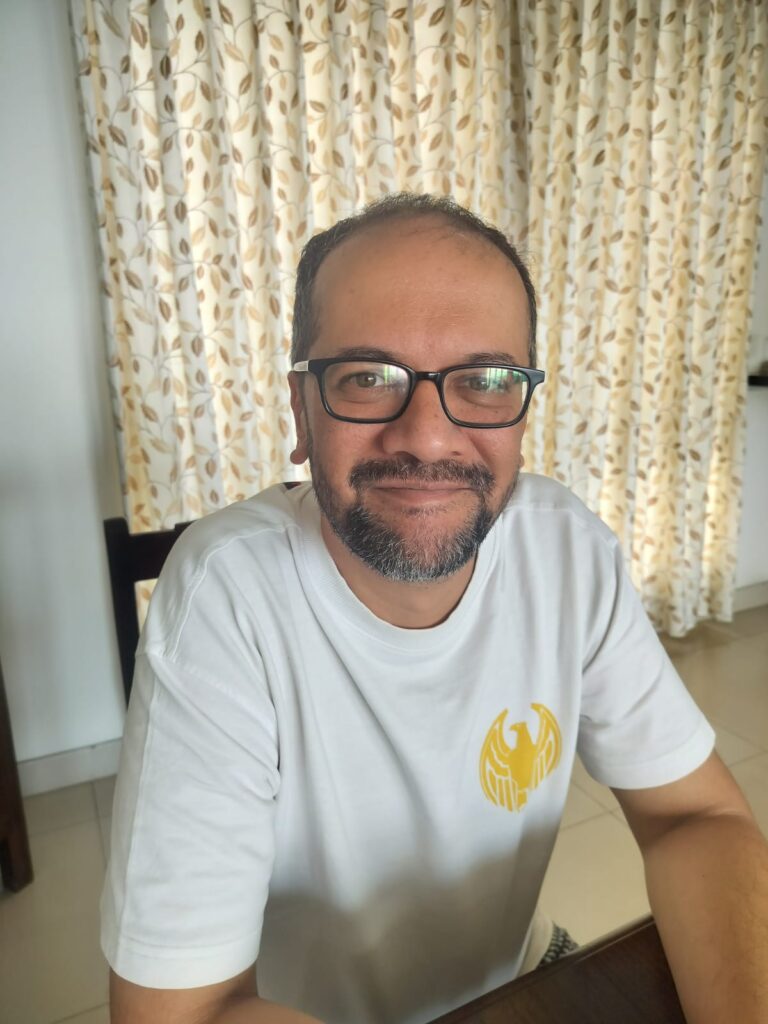
Vivek Madan is a theatre producer and actor based in Mumbai and Bengaluru. He is the founder of Bhasha Centre for Performing Arts, a theatre company that aims to build capacity through opportunity in playwriting and theatre producing.