The Sound of a City: Listening to Bengaluru’s Hidden Layers

Long before I notice the changing skyline, it is the city’s shifting soundscape that reveals where we are—and who we are becoming.
Every city speaks to its inhabitants in a dialect carved from its geography, history, and daily labour, but Bengaluru speaks in a dense, overlapping polyphony. Long before I notice the glass facades reflecting the relentless midday sun or the changing tree canopy along old residential avenues, it is the shifting sonic landscape that tells me precisely where I stand. I grew up in an older iteration of this metropolis—a city where mornings possessed a distinct, unhurried cadence. In the quiet lanes of Malleshwaram (560003), my childhood days began not with the sudden alarm of a smartphone, but with a layered symphony of domestic life. There was the metallic clatter of stainless steel filter coffee decanters at neighbourhood Darshinis, the deep, resonant chime of temple bells floating through damp morning mist, and the soft rustle of Gulmohar leaves falling onto swept granite pavements.
Yet, drive down the Outer Ring Road or through Bellandur (560103) just a couple of hours later, and that gentle hum dissolves completely into a formidable roar of modern transit, relentless infrastructure construction, and the distant, low-frequency pulse of high-density tech parks. As someone whose life has been deeply intertwined with the study of sound and space, I have come to realise that noise is rarely just an inconvenient byproduct of urban growth. Sound is the emotional connective tissue of city life. It quietly dictates whether we hurry past a concrete street corner with our heads bowed or linger thoughtfully in a public plaza, shaping our fundamental sense of belonging and peace.
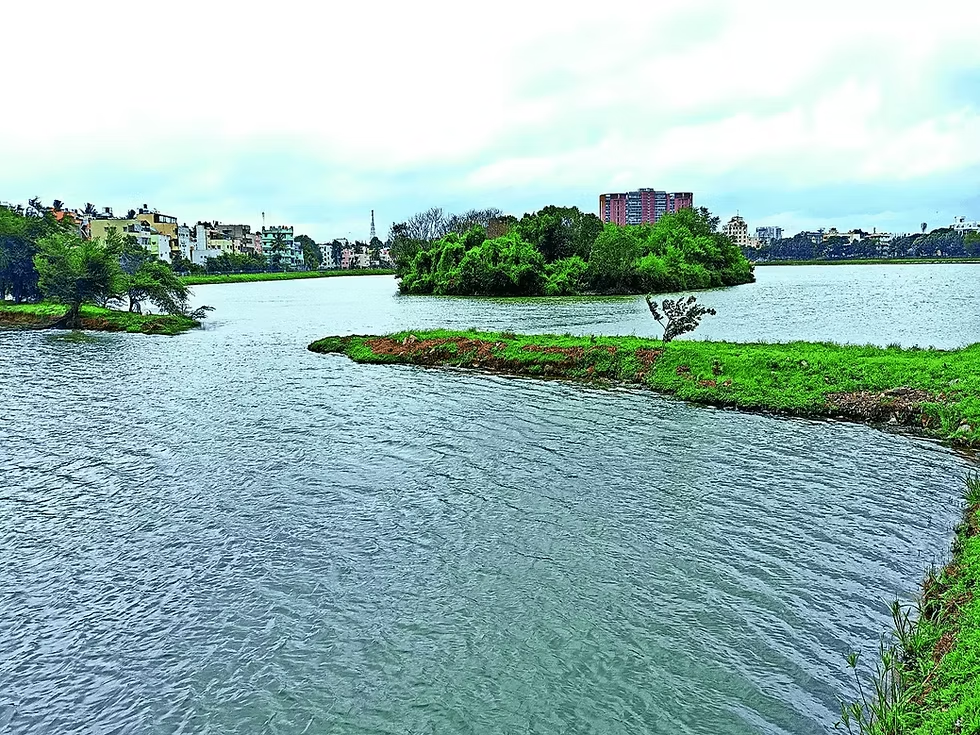
For decades, urban planning and architectural design catered almost exclusively to the visual sense. We designed for grand silhouettes, gleaming materials, and impressive scale, largely forgetting that our ears anchor us to place far more intimately than our eyes ever could. Today, a necessary movement is taking root among acoustic artists, spatial designers, and urban thinkers who argue that how a city sounds directly impacts human well-being. As our neighbourhoods grow denser and concrete replaces green sanctuaries, our primary task is no longer simply escaping harsh unwanted noise; it is intentionally nurturing meaningful, restorative soundscapes within the places where we gather, create, and reflect.
Designing a cultural venue or public performance space is never merely about isolating acoustic energy from the surrounding city; it is about tuning the architecture so that artistic performance and vibrant urban life coexist without structural compromise.
In our performance halls and cultural venues, acoustics act as the invisible bridge between storytellers and their audiences. Achieving true acoustic clarity within a bustling metropolis requires technical mastery and deep empathy for spatial narrative. Audio-visual integration specialists like qubix.in demonstrate what occurs when rigorous engineering aligns with architectural storytelling. A poignant example of this balance can be experienced at the Bengaluru Performing Arts & Cultural Centre, located near congested traffic arteries. There, engineers faced the formidable challenge of isolating delicate acoustic performances from the continuous rumble of heavy urban transit outside.
Rather than constructing an impenetrable, lifeless concrete box that isolated the building completely from its environment, the design team engineered a sophisticated room-within-a-room structural decoupling framework. Sitting inside during a quiet classical recital, one remains subtly aware of the vibrant metropolis humming beyond the walls, yet every intricate musical nuance reaches the listener with pristine, emotional intimacy. This delicate equilibrium proves that our cultural spaces do not need to retreat into total isolation to serve as sanctuaries for art. When we honor sound as a fundamental material of urban planning, we preserve the very soul of our collective living memory.
As Bengaluru continues its relentless expansion across new pincodes and sprawling corridors, preserving its auditory heritage becomes a crucial responsibility. The quiet courtyards of Basavanagudi (560004) and the historic tree-lined boulevards of Frazer Town (560005) offer timeless lessons in how natural materials, vegetation, and thoughtful spatial proportions absorb excess noise and foster intimate human connection. By applying these lessons to contemporary developments, we can build a city that honors both its energetic future and its reflective past.
Ultimately, listening to a city requires us to slow down and cultivate an inner stillness. When urban planners, architects, and citizens pay attention to the hidden auditory layers around them, urban design shifts from a purely utilitarian exercise into an act of care. By acoustic tuning our public spaces, workplace hubs, and cultural centres, we ensure that the modern city remains not merely a venue for economic transaction, but a vibrant, resonance-rich home for the human spirit.

Reflecting on my own journey through the shifting streets of Bengaluru, I am continually reminded that a city’s true character lies in its acoustic balance. From the quiet morning filter coffee rituals of my youth to the cutting-edge performance halls engineered today, our spatial experiences are defined by sound. Embracing this invisible dimension allows us to craft urban environments that nourish both the mind and the heart.
This delicate balance proves that our cultural venues don’t need to retreat from urban life to remain sanctuaries of art. When we treat sound as a sacred element of city-making, we preserve the very soul of our local heritage.