Cook, Serve, Repeat – Why I Love to Hate Cooking

Menu choices and constant expectations make cooking a less-than-enjoyable chore. Janani Sampath serves up a candid reflection on the daily grind of everyday home cooking.
In the film English Vinglish, Shashi, played by actress Sridevi, tells a French chef that when a man cooks, it is considered an art, but when a woman cooks, it’s considered just her duty or a chore.
The line has stayed with me ever since I watched the film, and it serves as a kind of copium for me whenever I feel challenged as I go about cooking.
I must confess that cooking has never fascinated me as much as eating has. I would do a hundred other chores rather than fix a simple meal at home. I have dodged it successfully over the years, during the single-woman phase and through many years of marriage, mostly because my mother and mother-in-law have supported me.
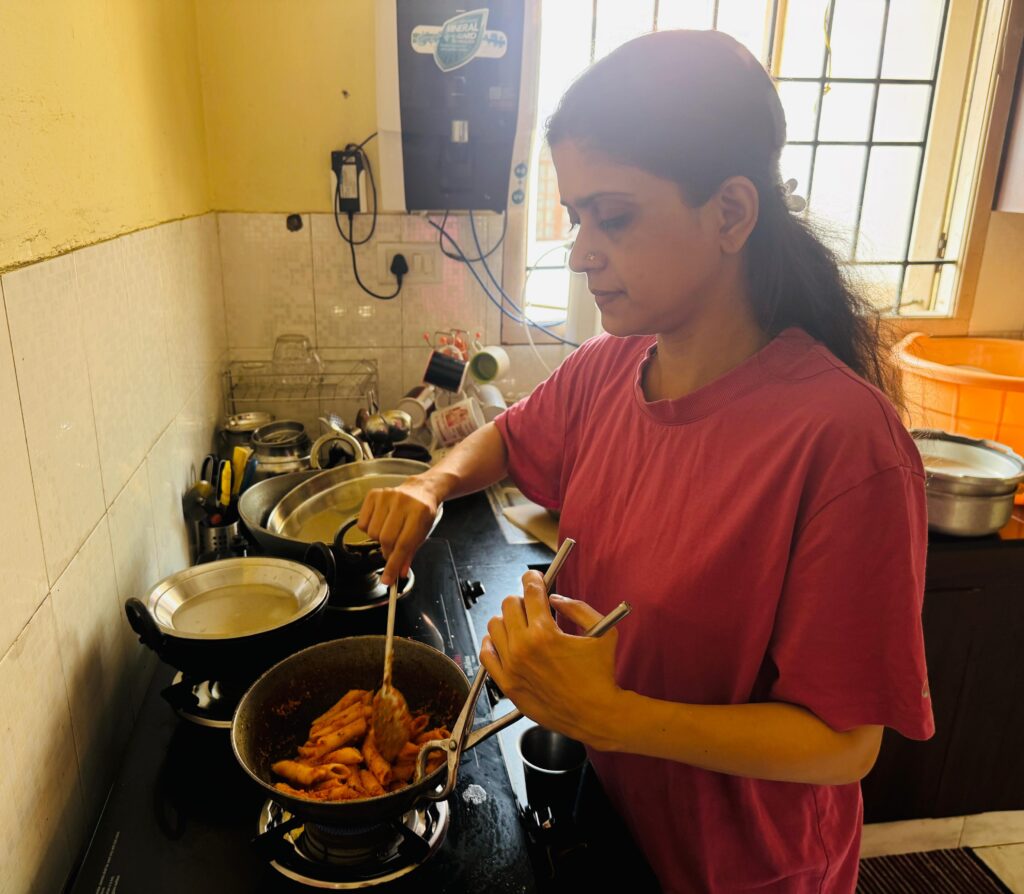
As Master Oogway in Kung Fu Panda said, “One often meets his destiny on the road he takes to avoid it.” I have recently had to become the cook-in-charge while my mother-in-law recovers from a surgical procedure. Since then, my mind has gone back to Sridevi’s words innumerable times. I have also discovered that cooking is not really one chore. There is deciding what to cook, checking what is available, remembering what was cooked yesterday, remembering what someone does not like, and remembering what someone likes but has not had in a while. Then I have to soak something that needs to be soaked, defrost something that should have been taken out two hours ago, and, of course, answer the inevitable question: “What are we having for dinner?”
I sometimes wonder if this question is asked because people genuinely want to know or because they have appointed me the unpaid menu consultant of the household. And there is something particularly exhausting about cooking every day. It is not the elaborate Sunday menu comprising all that was skipped during the week, or the occasional cake that you can whip up with some excitement. It is the sheer repetition of it. Breakfast, lunch, dinner; it is almost as if the people you live with have made a secret pact to remain hungry at regular intervals.
The irony is that I do enjoy feeding people, as there is something deeply satisfying about watching someone enjoy something you have cooked. I understand why food is called an expression of love. There are memories attached to certain dishes, tastes that take you back to childhood and recipes that somehow carry the people who made them.
My mother can make a simple rasam taste like a wedding special. My mother-in-law can produce an entire meal without making it look like she has been anywhere near a kitchen. I, meanwhile, can spend considerable time planning a meal and still find myself staring into the refrigerator, wondering whether I can make do with some insipid beans lying abandoned for days.
The aftermath of cooking and serving is all the more eventful with an occasional complaint: “Oh, you missed some salt this time.” Or, “It doesn’t taste like what you prepared the other day.”
Often, cooking became less about feeding people and more about fulfilling an expectation. A woman may have a full-time job, deadlines, meetings, children, ageing parents, bills and a dozen other things occupying her mind, but somehow the question of what everyone will eat hovers constantly. There is a difference between cooking because you want to cook and cooking because everyone assumes you will. Maybe cooking is not the enemy after all, and it is the expectation attached to it that I have been fighting.
Even when there are several people in a household who can cook, the woman often becomes the default manager of food. If she is not cooking, she is expected to know who is cooking. If nobody is cooking, she is expected to figure out what everyone will eat.
When the burden seems to reduce a bit, like when the husband steps in to give me a day off, it is not time out! I am fetching the ingredients he is shouting for in the kitchen, finding the vessel of a particular size for the tadka, and the unheard-of spice he wants to add to his sambar today. All while he is being cheered and applauded by my folks for being such an amazing cook.
I am beginning to understand what Shashi was really saying. When cooking is seen as a woman’s duty, nobody notices the skill, time, creativity and care that go into it. It becomes invisible precisely because it is expected. Perhaps that is why I still love to hate cooking. I am not particularly fond of being told that my original place is in the kitchen and my life should revolve around it.
And if destiny really has brought me to the kitchen after all these years, I would like to think I can at least negotiate the terms of my employment.