The Musician Who Never Left Literature
Krishna Manavalli reflects on the extraordinary life of her guru, Pandit Rajeev Taranath, celebrating the acclaimed sarod maestro’s enduring legacy as a musician, literary scholar, teacher and mentor.
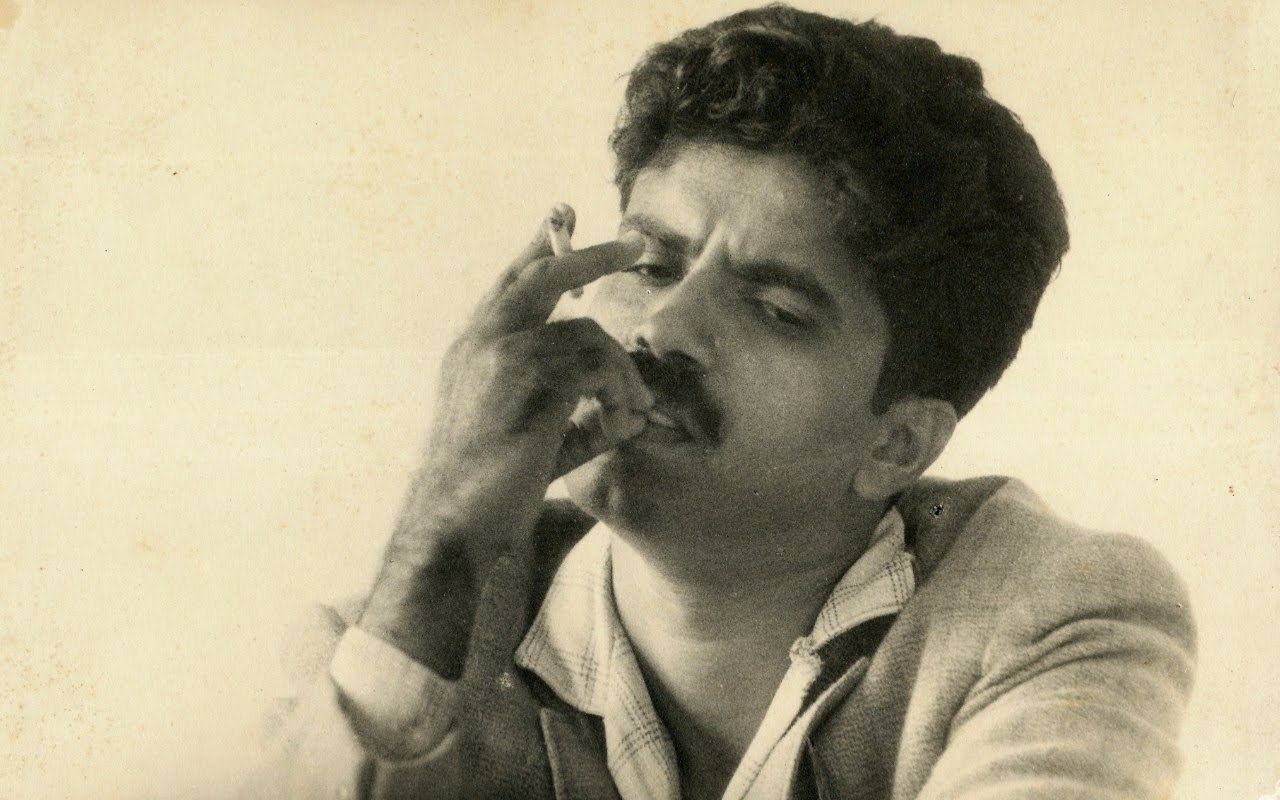
That sepia-tone photograph keeps me mesmerized. The first time I saw it in postcard size was decades ago, in the late 1980s. Now, as you enter my house, an enlarged version of it faces you, hanging on the wall opposite the front door. You cannot miss the intrinsic drama about it. The story it tells dates back to the 1960s and 1970s, when the man in the picture—with his dark “demonic” charm, half-closed eyes, inward-looking gaze, and the impish angle of holding the cigarette between his fingers—taught English brilliantly to several students on whose lives he left an indelible mark. If you look closely, you see something else, too, in that picture: a difficult time borne with great human dignity. The nicely cut checked coat is frayed just a little at the collar. The old photo gives us a slice of life from his English-teaching days. This is also how several English literature students of his remember their bohemian-looking, chain-smoking teacher, carelessly dressed and with that famous shock of hair (which he still had at 91!).
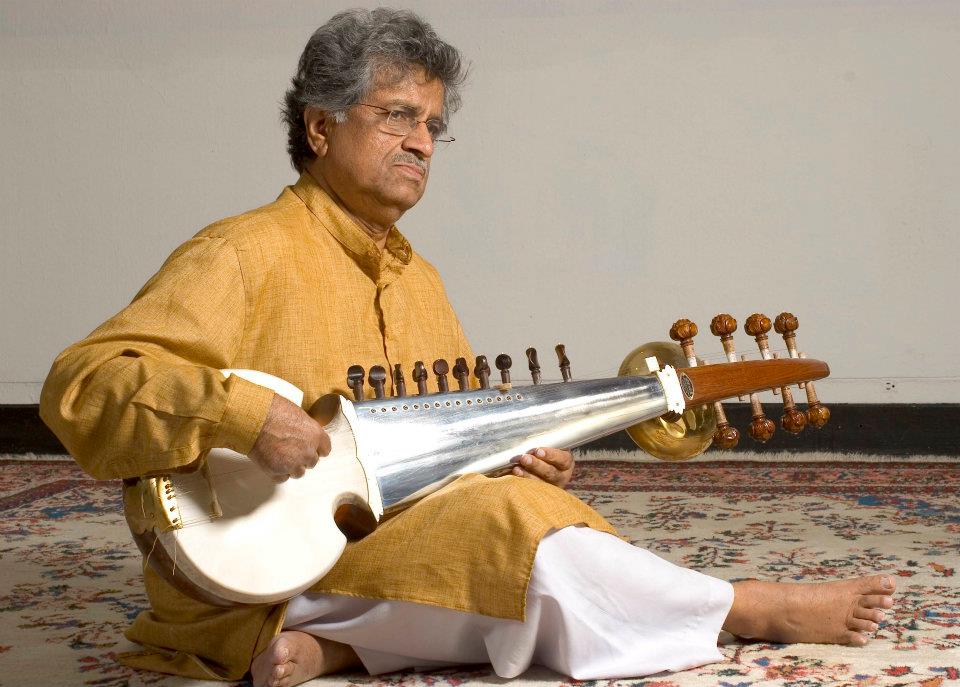
Rajeev Taranath at a performance.
Much later, I met the man in that iconic photo, my Guru, the sarod maestro and eminent literary scholar Pt Rajeev Taranath, in 1988. Guruji told me of the times when the photo was taken as we sat in the old house his mother built in Jayanagar in Bangalore. In over three decades that I was privileged to be with him, I heard more and more about those English-teaching days he cherished, despite the hardships he went through. Financial troubles, personal dilemmas, and the need to do a 10-to-5 job to support a family—all these made the restless musical genius fret about not giving himself up entirely to the love of his life, the sarod. He moved from one place to another—Mysore, Dharwad, Raichur, Trichy, and later Hyderabad—teaching English. All he wanted was just a little more time with the sarod. Yes, he practised, gave a few concerts, and taught music too. But he felt that English and English teaching took him away from the sarod, until one day in the 1980s, one of the trinity of his Gurus, Pt Ravi Shankar, made him give up English teaching and devote himself entirely to music. The rest is history. Rajeev Taranath rose to become a globally renowned sarod maestro who received the country’s highest awards for music, including the Sangeet Natak Akademi Award, the Chowdiah Award, the Padma Shri, and others.
June fills me with thoughts of Rajeevji. Two years ago, he breathed his last on June 11, 2024. A music guru, father, and literary mentor, he shaped my mind in every walk of life. What is more, he is my model in my translational endeavours too. Guruji’s translation of his lifetime friend Kambar’s Jokumaraswami exemplifies to me what he meant by “seamlessness” in translation. As many are aware, this multifaceted Renaissance personality, alongside being a magnificent musician, also left us a rich literary legacy.
Rajeevji’s love of the English language and literature lasted throughout his life. The admiration that his students of yesteryear feel for him even today gives me an idea of how intense and vibrant his classes must have been. His path-breaking work on Indian English writers like R. K. Narayan, Raja Rao, and Nissim Ezekiel; his writing on T. S. Eliot, which made him the first Indian to be referenced in the famous Arden edition of Shakespeare; and his being at the forefront of the modernist Navya movement in Kannada literature were achievements of the highest order.
When I met Guruji, he was all of 56 years old and at the height of his musical career (though many of us, his admirers, feel that a maestro of his calibre did not get his due recognition). As usual, he kept telling me that he had bid goodbye to literature. But I found among the daily stream of visitors to his house almost as many writers and literary types as musicians. Writers, film and theatre personalities like Vasudevan Nair, Ananthamurthy, Chandrasekhar Kambar, and Girish Karnad, to name a few, came to his house. In addition to his short stint as a professor at the Poona Film Institute, Rajeevji also gave trend-setting music to the New Wave cinema in Malayalam and Kannada, working with greats like Aravindan, Vasudevan Nair, Pattabhi Ramireddy, and others. In some conversations, Guruji told me that literature gave him some cherished moments. His splendid insights into literature, relish for the beauty of language (he spoke nine languages with ease), and the brilliance with which he used English, added to his radical political, social, and cultural stances—all these made intellectual conversations with him as mind-blowing as the music sessions. As he reclined on his big armchair and spoke, what flowed was a word-perfect article or speech, just like his perfect musical compositions.
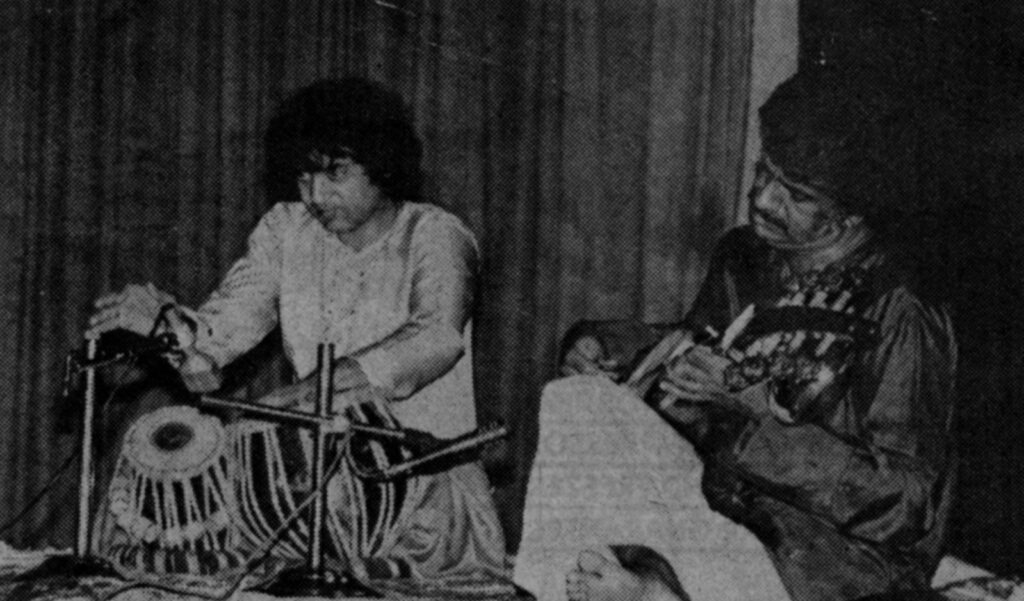
Rajeev Taranath with tabla maestro Zakir Hussain
Curiously enough, although Guruji worked on Eliot for his PhD, W. B. Yeats was the poet after his heart. The lines he often read from Yeats, whether they were about the Celtic hero Cuchulain who “fought the invulnerable tide”, or the old man with a “love on every wind”, or even from the Byzantium poems, still ring in my ears. Guruji was fond of rejecting his own writing from the Navya era. But he retained his love for many Navya writers like Adiga, Kambar, and Ananthamurthy. He also admired older works like Kumara Vyasa’s Bharatha. His range of reading was vast, extending from books on the World Wars to Boswell’s Johnson. What drew him particularly to poetry was his fascination with the play of language, its rhythms, tones, and musicality. Dante, Shakespeare, Donne, Hopkins, Rilke, Auden, Wallace Stevens—the list was long.
All through life, Guruji made a sacrosanct space in his being for music. The sarod meant order and meaning in life. It was this discipline that kept him practising the sarod even a couple of days before his fall and hospitalization. He taught his disciples music even in the hospital. In fact, he taught me a composition in Raag Jhinjhooti there. And in the ICU, even when he was unconscious, his fingers kept beat to the music we played for him on a recorder.
Above all, another crucial aspect of Guruji’s personality was his humanity. A people’s person, he gave of his largesse to those in need. Educating poor students, supporting domestic staff, helping upcoming musicians—he was always there for others. Nobody who came for help left empty-handed. After all, idealism and high-mindedness were ingrained in him in childhood by his illustrious parents, Pandit Taranath and Sumathi Bai, who, in Guruji’s words, “walked tall on this planet”. I once asked Guruji about the rich contradictions in his personality. He defined himself as a classicist in music. But he was an incurable romantic in many other aspects of life. Guruji explained that, for him, romanticism meant idealism. If one side of him was a relentless seeker of excellence in an impersonal art like music, the other was an intensely feeling heart. In fact, for him, love meant “worrying”—worrying about someone or something, worrying about people, and worrying about society.
Every moment of every day, something reminds me of Guruji. His day began with getting up early in the morning for sarod practice. Later, he sat outside and sometimes mimicked the birds in the trees. They would stop chirping for a moment. Then suddenly, they chirped back at him in a frenzied manner. Guruji’s particular taste in morning coffee (the bean had to be Arabica), his singing, playing with the pet golden retriever, relishing his favourite food, lounging on the La-Z-Boy with a kingly air—our house was full of his presence. Sometimes, I almost hear him calling me, “Ee Papa…..” (Hey, child). After two years, it is still difficult to believe that he is not there somewhere in the house.
[Parts of this article are drawn from Epiphany, a volume in memory of Pt Rajeev Taranath (2025).]

Krishna Manavalli is Professor and Chairperson of the Department of Studies in English at the University of Mysore, and a noted literary critic and translator working in both English and Kannada. A former member of the Central Sahitya Akademi’s English Advisory Board, she is a Karnataka Sahitya Academy Translation Award recipient whose translations have brought the works of several leading Kannada writers to wider audiences.
Click here to view Pandit Rajeev Taranath’s last interview – “Salvation is in a clean, good note of music” – Pandit Rajeev Taranath in Spotlight with Sandhya